


There’s a nice, traditional model of sales that depicts the buyer’s journey as a funnel: you feed in leads at the top and customers will drop out the bottom, a bit like a sausage machine. It’s generally shown as looking something like this:
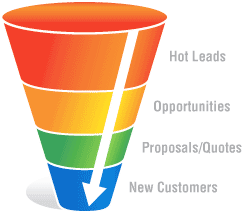 Now it would be very convenient if the world really operated like this, but in reality it’s somewhat more complex, particularly in the world of business-to-business sales. Yes, it’s worth trying to map out how your customers buy from you but you’ve got to be prepared for a bit of human illogicality too, especially if you’re selling a complex or high-value product, where the sales cycle may be quite lengthy and there are multiple touch points and opportunities to influence your prospect.
I was reminded of this recently when we signed up a new client. She contacted me through LinkedIn to see if we could help her having read one of blog posts (Touch Point 3) and then we arranged to meet (TP4), which led to a written proposal (TP5). In the meantime, I delved back through our CRM system to see what the history of the relationship was. It turned out that she had come to one of our regular seminars a couple of years ago (TP1), invited by one of our guest speakers. At the time, she’d not had any immediate need but had signed up to this blog and to our newsletter mailing list (TP2). So far, then, this was a pretty conventional journey, following a series of touch points that we could track and control.
But what made the difference in generating the sale were two important developments in the last six months over which we had no control: she decided to set up her own business and found she needed help with working out what marketing she should be doing. And, critically, she discussed this with a business contact at her accountancy firm, who was aware of RCR because they do work for one of our other clients (and, fortuitously, we’d met up with this accountant at a networking event not long before). So we could argue that the factors that really led to the sale were unpredictable and beyond our direct control, or ability to track.

So what are the lessons I’ve learned from this?
- The sales process is not a sausage machine BUT those five touch points mentioned above all had a role to play: process is important in keeping your name in front of people over a long buying cycle.
- The importance of word of mouth and personal relationships; process and marketing automation can be very powerful but, at the end of the day, we are humans not robots and we don’t always act in a linear, logical, track-able fashion.
- So we need to cater to both factors in predicting our buyer’s journey: sometimes they’ll follow the satnav directions to the letter, and sometimes they’ll veer off down country lane just because they feel like it and the view looks nice.
by Victoria Ash
